Better Bending: Analysis, Construction and Verification of Discrete Bending Models for Kirchhoff-Love Shells
Abstract
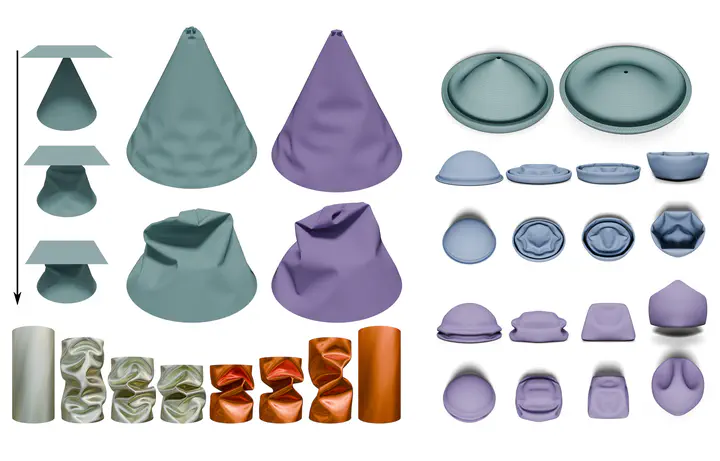
While thin shells have ubiquitous applications and have been studied inside and outside computer graphics for decades, there is little consensus on how to best discretize them. We systematically study models for simulating bending of Kirchhoff-Love shells, with the goal of making practical recommendations, backed by careful numerical experiments, of when and how these models should be used. We analyze ten of the most popular discrete bending models in computer graphics for thin-shell simulation, along with new variants that we propose ourselves. We first verify all models on an analytic test benchmark to probe convergence under refinement and mesh-dependence, and then stress-test with a second benchmark that considers behavior at sharp bends. Finally, we test benchmark leaders on a practical suite of challenging large-scale equilibrium and dynamic shell modeling problems, analyzing both full solution behavior and comparative compute costs. We identify leading existing models and their tradeoffs in terms of accuracy and performance. During this analysis we also identify some issues and modeling gaps in the best-performing discrete bending models. We construct new energy model variants to address some of these gaps, as well as formulas and algorithmic tools for their practical simulation, and finally recommend best practices for modeling thin-shell bending.